
Tag: North American Ski Training Center

  • Holiday Gift Ideas

    Holiday Gift Ideas

    Don’t know what to get the skier who has everything? They’ve got the clothes, the gear, the gadgets, the season passes, they’ve even booked and paid for a ski clinic with NASTC already? Really? Well then, here’s some ideas:

    SkiA Sweetspot Trainer
    If you are not able to dedicate as much time as you would like to your dryland training, there is a tool that can help you ski better before you even click into your bindings. The SkiA sweetspot trainer is a balancing aid that will help you achieve better balance over your base of support (your feet). You clip the device onto your ski boots and forces you to find the optimum balance point as you stand, move around, tip and twist your feet. You find out very quickly what adjustments you have to make to not fall down and what muscles groups need to fire to assist in making and maintaining those adjustments. Check out the video link below “How to Use a SkiA Trainer” with Chris Fellows. http://youtu.be/wAVhaUyUJPA

    Women’s Ski Day
    Along with Coaltion Snow, we’re offering a Women-Only ski day at Sugar Bowl!
    December 13, 2014 l Sugar Bowl Resort: Get your season on and celebrate International Women’s Ski Day! We are partnering with CoalitionSnow.com to help you fine tune your skiing skills before the season gets underway. Join this high-touch, high-impact all-mountain free-skiing clinics for intermediate to advanced skiers. Our instructors will do nothing short of improving your skills in a non-competitive and super fun environment. Only $75 secures your spot. Fee does not include lift tickets or food/drink. (But we know you have those four tickets from your Alpine/Squaw pass and now’s the time to cash one in.) Minimum 10 people required to run. Click on the link below to register. https://secure.squarespace.com/commerce/donate?donatePageId=544671d8e4b0664ae93f2c86

    Total Skiing – THE book
    If you consider yourself a serious student of the sport of skiing, this is a great resource. What type of skier are you? What are your strengths? What are your weaknesses? How can you improve your skills and your downhill experience? Total Skiing was developed specifically to help you answer those questions.

    Author/ski instructor Chris Fellows shares his proven pyramid program for assessing skills and creating your skiing profile. Step by step, you’ll identify exercises to enhance those skills and create a personal training program to improve functional movement, including stability and mobility, ski-specific fitness, essential ski techniques, and tactics for performance on all terrains.

    Total Skiing also includes sample programs for each skier type that offers guidance from preseason to postseason with dry-land and on-snow drills for foundational, intermediate, and advanced performance solutions.

    Whether you are looking to polish your skills, conquer the new terrain, or compete on circuit, Total Skiing is your total guide to exhilarating all-mountain skiing! Email NASTC for your copy, on sale now! [email protected]

  • This is how the Men’s US Ski Team Gets it Done!

    This is how the Men’s US Ski Team Gets it Done!

    Men’s speed group charged through Napa on bikes

    by Hank McKee
    Published by Ski Racing

    Get a bunch of large athletic men together, put them in a competitive environment and you got yourself a testosterone fueled freight train. That train, consisting of the men’s speed group of the US Ski Team, recently ravaged the roads of Napa, California on bikes, riding between 60 and 100 miles day, sleeping on the beach and eating an incredible amount of food.

    “It was a chance to kind of shed the winter coat and get working so that we can train harder and have more power when it gets closer to race time,” said Marco Sullivan. “In five days we covered 400 miles on road bikes, camping on the coast on the beach every night. It was simple living for sure” Get up, put the shorts on and start riding. Ride all day, stop for lunch, get into camp at night and set up tents and each as much as we could.”

    Speed coach Tommy Eckfeldt was the trip organizer said the “Tour d’Cali” originated as a way to drive the conditioning program in the preparation period and to simply travel it was tacked on to the end of an on-snow camp at Mammoth.

    “It was great fun once we were able to start riding as a group. The last day heading into Napa from the coast they averaged around 28 to 30 mph. These are back roads with a 50mph speed limit. Cars were having trouble passing us on the downhills.”

    Eckfeldt said the narrow roads necessitated a lot of single file riding, but outside from the expected flat tires and a broken derailleur, there weren’t many problems. “We were pretty well prepared for the minor stuff,” he said, and they simply sought out a bike shop when they ran into more complex problems.

    They ran into one day of poor weather and had the opportunity to cool down (recovery) in the ocean. “You couldn’t have asked for a better situation,” he said.

    “The whole idea was great,” said Andrew Weibrecht. “It gave us something to focus on and train for, and then the actual trip was really good, basically hammering Napa and up and down the coast. There were no stragglers. It definitely schooled the competitive vibe in a good way. It was a great way to really kick off the summer training, shocking the system like that.”

    Weibrecht said the bulk of his riding before this trip had been shorter rides, ones, he said, he had been able to complete essentially using his quad muscles. The longer rides of the Tour d’ Cali meant using a whole new set of muscles. “I pulled in ways I never pulled before,” he said. “It was cool to know you can do something like that, meet a challenge like that.”
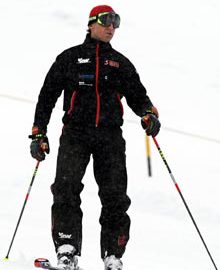
    “We put together some decent rides,” said Eckfeldt. “camped at national park sites, set up tents, had bonfires and made good time.”

    About the only thing that slowed the train up was a work zone woman holding a stop sign.
    “Yeah we were on a 101mile leg, coming down a hill and it turned into a construction lane,” said Eckfeldt. We waited about 20 minutes and we had been averaging 27mph up to that point.”

    Eckfeldt said Steven Nyman was at the front of the pack more often than not. “An incredible motor and horsepower,” adding that Weibrecht spent plenty of time among the leaders and that Travis Ganong was right up there as well.

    “It was hard work for sure,” said Sullivan, “but having all the guys there made a team bonding thing as well. Nyman was our workhorse, he was at the head of the pack a lot, but we got into some good biking strategy, taking turns at the lead. We thought we were pretty cool.”

    The bonfire sessions, after dinner, didn’t usually last very long.

    “We camped pretty much on the cliffs,” said Weibrecht, “rode up the coast, looped through the Redwoods. We were definitely blitzed by the end of the day. About 8pm guys started nodding off. The biggest obstacle was falling asleep when it was totally sunny.”

    With a couple of chase vehicles, conditioning personnel and a nutritionist on hand, the team had little to worry about but keeping the train running over the rolling hills of Napa. – Hank McKee

    Photos by Steven Nyman

  • New U.S Ski Team Women’s Tech Coach

    New U.S Ski Team Women’s Tech Coach

    New U.S. Women’s Tech Coach Pfeifer Sees Promise

    By Eric Williams
    Published on Ski Racing

    Recently named U.S. Alpine Ski Team women’s tech coach, Roland Pfeifer has his work cut out for him.
    The Austria native is charged with bringing the program “up to speed” after last season saw the team pull in a meager 10 top-10 results and just one podium. Though he hasn’t met most of his new stable of athletes, he’s already formulating plans for the season and anxious to hit the southern hemisphere snow later this summer.

    Pfeifer comes to the U.S. Team with a wealth of experience as both an athlete on the World Cup and U.S. Pro Tour as well as a coach at Ski Austria feeder program, Vorarlberg Ski Team. After his daughter turned 18 in January, he made the decision to hit the road and step up to the sport’s top level.

    Pfeifer will focus most of his efforts on working with gate racers Sarah Schleper, Resi Stiegler, Hailey Duke, Megan McJames and Mikaela Shiffrin, while occasionally providing support to all-around skiers Lindsey Vonn and Julia Mancuso.

    His recipe for success calls for fun, communication and lots of work. “We need to make them ski relaxed. We need to bring some fresh motivation and fun into the team,” said Pfeifer. “We need to convince them of what we are doing and we need to talk a lot, and train a lot.”

    “I haven’t met them yet but I know Schleper and Stiegler are top competitors and can get to the top-10 many times this season and some podiums as well,” continued Pfeifer. “Duke and McJames’ goals will be to consistently make the top 30 and progress up from there.”

    Pfeifer’s first exposure to his new squad came last week at an on-snow camp in Mammoth with reigning slalom national champion, 16-year-old phenom Mikaela Shiffrin.

    “I’ve got this unbelievably talented and gifted Shiffrin. She is skiing like a grownup already,” said Pfeifer after spending several days on snow Shiffrin. “I’m not putting too much pressure on Mikaela because she is 16 years old, I’m not going to set any goals for results, just to qualify top-30.”

    While Pfeifer isn’t setting result expectations for Shiffrin, he is confident she is ready to compete with the world’s best. “She shows really good skiing, I like the way she skis and I like her,” said Pfeifer. “I’ve never met a 16-year-old that knows so much about skiing and she loves it. There is no reason to hold her back, I see her absolutely competing on the World Cup circuit, no doubt about it.”

  • Ski Tip: Pole Usage

    The function and correct use of our poles can seem as ambiguous as a politician’s speech.  Good pole usage complements and aids upper body movements in dynamic skiing.  Missing pole plants, poorly timed pole plants or directionally inappropriate pole swings can create dysfunctional elements in your skill set.  Diverse terrain requires attention to rhythm and strong core movements that are directed down the fall line.  The pole swing is timed with an extension move at the start of th turn, this aids in directing your momentum toward the apex of the turn.  As the pole is planted it helps stabilize your body as you change from the uphill set of edges to the downhill set of edges.  The pole swing should originate from the wrist and not the elbow.  As your turn shape changes, the direction and timing of your pole swing adjusts accordingly.  When skiing steep terrain and bumps your pole swing will directed more towards the fall line rather than the apex of your turn, your pole plant will happen as you pull away from the fall line and the skis turn across the hill.  Next time you are out on the hill think about the timing and directionality of your pole swing and plant and what it does to your rhythm and stabilization of the upper body.

  • Nutrition & Skiing

    We talk alot about physical training and how it is necessary for performance and longetivity in our sport and the important role it plays in injury prevention.  Another aspect of training that we tend to overlook is nutrition.  Nutrition has an equally important role in increasing performance, longevity and injury prevention.  With skiing our dietary habits change fwhether we are in Pre-season or Post-season and In-season.  We need to keep in mind how to fuel our body adequately to maximize the benefits.  One of the beliefs that works for me is “Clean Food,” this is my own title that I have given to minimizing processed foods out of my diet.  This has helped with monitoring my sugar and fat intake, if it is not naturally occurring sugar (like fruit or honey) then I don’t eat it.  Likewise with carbohydrates, if the grain is not in its natural state then I try to avoid it.  Thanks to spending the summer in Portillo last year, I now have a new appreciation for quinoa. Quinoa is an indigenous grain to Chile and they eat quite a lot of it.  When I am working out I try to increase my protein intake to help fuel muscle recovery, I try really hard to make sure that there is some source of protein in every meal that I eat.  Off-season nutrition is the easiest to manage – for me.  In-season nutrition I find is the hardest to manage.  As the temperatures drop we tend to crave those high in fat comfort foods.  The resort dining selections do not offer much in terms of healthy options.  I think the biggest mistake we make nutritionally during the season is the quantity and quality of how much we eat and how little we hydrate.  It’s easy to walk in to the resort’s cafeteria at lunch time, and grab a slice of pizza “because it’s quick,” or a burrito or a cheeseburger and fries – because your stomach is growling and these are the options that are put infront of you.  After wolfing down your food and soda, it’s hard to even think about going outside and skiing much less ask your body to perform optimally.  We don’t need to eat that much at lunch and we very likely need to double our intake of fluids (the hydrating kind).  The point is, we have to pay better attention to what we eat in season and off-season to solicit the best performance from our bodies, reduce our risk for injury and increase our longevity in the sport.  Consult a local nutritionist to put together a plan that is best for your body and needs.

    By Kim Mann – NASTC Trainer & Western Regional Team Member

  • Daydreaming about Portillo……..

    Counting down the days till we are in sunny and snowy Portillo.  That place is so much fun, it’s a wonderland for skiers.  If you like to ski and you like to have fun, this is where you need to go this summer.  We can hardly wait to ski under the brilliant blue Andean sky, miles and miles of terrain infront of us with the breathtaking Lago del Inca as a backdrop.  The skiing at Portillo is just downright fun, there is a level of challenge for everyone.  Even the thought of riding up the Rocajack or Cara Cara lifts make you want to chuckle.  Then there is the delicious food and of course dessert.  Portillo has some of the best ice cream around in unique delicious flavors like, Lucuma, Maracuja, Chirimoya, and Manjar.  And there is the ‘mil hojas’ cake that is sooo good.  It’s a good thing we ski everyday otherwise we’d be in trouble.  One of the fun things to do is hit the bar after dinner, when the band starts playing and watch the place go off.  If the band is particularly good, you will get people dancing on the tables, the windows will steam up and it’s a good time whether you jumping in on the action or just watching it.  Then there is the disco, which can be hit or miss, it kinda depends on the crowd.  Don’t miss out on La Posada if you want to an authentic cultural experience.  The bbq’s in the Posada are always a great way to start the night.  Everyone’s favorite spot is Tio Bob’s.  What is there to not love about this place.  When the sun is out, you can sit outside and take in the phenomenal view.  The salads up there are the best!  The best part about Portillo……the people!  Everyone is so friendly and you get to meet some of the nicest and coolest people.  You don’t miss summer one bit while you are there, if you do, just head down to the pool (it’s heated) or hot tub with a beverage and you’ll forget just about everything.  C-H-I….Chi L-E….Le, chi, chi, chi, le, le, le VIVA CHILE!

  • One of the Best Days of the Year!

    The skiing out there is unreal!! Probably one of the best spring skiing days ever! Hands down.  The mountains are buffed out and smooth and the snow is just right.  Get out there and make some turns you will feel like rockstar.  You can go just about anywhere as the coverage is great and the conditions are so forgiving.  If you are backcountry buff, there is a gold mine out there – have fun!

  • A Great Article on Portillo

    Here is a great article that sums up the Portillo experience albeit it was written a few years ago.  The essence of what it is like to visit Portillo is difficult to capture as Portillo “hits” everyone differently.  http://www.everettpotter.com/2006/07/summer_skiing_i/

  • Zeb’s Most Recent Eastern Sierra Adventure

    Zeb’s Most Recent Eastern Sierra Adventure

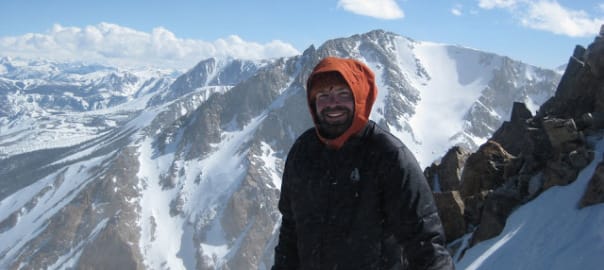
    NASTC guide Zeb Blais at the top of East Peak, with Mt. Gibbs in the background

    Wind ripping across Dana Plateau and deposting snow on the eastern flanks of East Peak