|

|


|
|
|
|
|
|
|
|
|
|

In the stirring World Cup final on Sunday between the national men’s soccer teams from Germany and Argentina, an American played a role on the field in Rio de Janeiro despite the United States team’s having been eliminated. Sitting and occasionally pacing tensely along the German sideline was Mark Verstegen, the team’s trainer.
Mr. Verstegen, the founder and president of EXOS, a Phoenix-based company that trains professional and recreational athletes and corporate executives, was appointed in 2004 by Jurgen Klinsmann, then the coach of the German team and now the United States coach. He was brought in to improve the players’ fitness, agility, nutrition and resilience. At the time, the Germans were at a low ebb by their high standards, having not won a World Cup since 1990 or a European championship since 1996. Mr. Verstegen said his appointment was met with widespread incredulity among German fans, news media and even some players.
“They wondered what Americans could possibly teach” the German squad, he said.
Then the Germans advanced to the semifinals of the 2006 World Cup, performing better than expected, and on Sunday, the team won this year’s edition, defeating Argentina, 1-0, in extra time after having routed the host Brazilian squad, 7-1, a few days earlier. There aren’t many skeptics about Mr. Verstegen’s training methods now.
To learn more about how he trained the German team and how the rest of us might adapt some of their routines at home, ,I spoke and emailed with Mr. Verstegen in the days leading to and just after Germany’s title victory. (His book, “Every Day is Game Day,” was published in January.) What follows are excerpts from our conversations.
Q.
What were the logistics of training the German team at the World Cup, given that the team was traveling from city to city?
A.
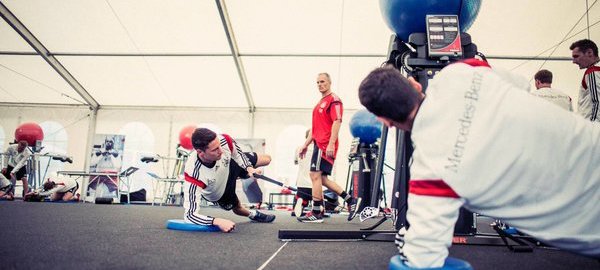
We have a pretty amazing mobile training camp. It’s a 4,000- or 5,000-square foot structure that we erect adjacent to the pitch. It holds the latest cardiovascular machines, weights, fitness and recovery gear, treatment tables and so on.
Q.
What would a typical World Cup training session in that facility look like?
A.
It would depend on how close we were to the next game, but we’d often divide the structure into four stations, a mini-circuit, with a different exercise at each station. We might have the players do things like a T-Hip rotation exercise at one station and a miniband lateral walk at another. That’s where you strap a band across the thighs or ankles and walk sideways. We were ridiculed in 2004 when we had players exercise that way. But hip stability is essential for soccer performance and injury mitigation. People don’t laugh about it now.
Q.
After a session in the facility, then what?
A.
The team goes onto the field and does drills, lots of drills, working on agility and acceleration and building power. We might have them do lateral and cross sprints, drop squats, running with the parachute or the Bullet belt [a harness worn by the player and attached to a long rope held by a coach]. After that, there’d be technical and tactical work with the ball.
Q.
How different are these sessions from the training that the German team did before you arrived?
A.
There was more emphasis then on the technical and tactical elements. The physical training was very general, with lots of long runs. Now the players still spend lots of time working on technique and tactics, but their physical training is more focused and individualized. We constantly assess players’ movement patterns, for instance, watching as they perform every exercise. Precision is very important. If they’re slightly off in their movements on any particular day, we correct things right away. It’s like running an antivirus program on a computer. You want to get rid of the junk and keep the movements precise.
Q.
Just how fit is the German team?
A.
I can give you precise numbers on that. The German players covered 113.8 kilometers, or about 71 miles, on average as a team per game in the group phase. Only the Americans ran more as a team. In the quarterfinal round against France, German players ran 7.5 kilometers, or about 4.6 miles, more as a team than did the French side. That translates to about three-quarters of a player more on the pitch.
Q.
How can you tell how much players are running?
A.
All of the players wear monitors in their cleats that track their mileage, movements, where they are on the field, when they stop and start, and all sorts of additional data. We track every player’s every heartbeat and keep and compare data from practice to practice and game to game. We repeat certain drills, and if someone is performing the same drill with a lower heart rate or faster speed, we know he’s improving. If he’s slower or his heart rate stays elevated, we monitor him to make sure that’s he’s not becoming overly fatigued or ill, then get him to push himself a bit more.
Q.
Any suggestions on which aspects of the German team’s training program those of us at home might usefully incorporate into our exercise routines, even if we aren’t soccer players?
A.
The broad elements of the training program apply to anyone. Concentrate on your mind-set, nutrition, movement patterns and recovery. On a practical level, get plenty of sleep, which is extremely important and often overlooked. Kick the electronics out of the bedroom. At the other end of the day, when you first wake up, do a few push-ups or yoga poses, anything that gets your body and mind primed for activity. You’ll be more receptive to activity throughout the day. Then try to do whatever exercise you do a bit better every day. You don’t have to be doing split squats with kettle bells, but do something that pushes you a bit. The point is that the body and the brain respond positively to having demands put on them. That’s really the key to fitness.
Q.
Are you happy with the outcome of that last World Cup game?
A.
Utter elation. We had put in 10 focused years of attention to details. There are no givens in sports, but once that whistle blew, it was utter joy.
Roll Your Glutes Like Bastian Schweinsteiger
To lessen the chance of injury and improve performance, we all should ease into exercise with an orchestrated warm-up, Mr. Verstegen said. These eight exercises approximate a typical warm-up for the German national soccer team, so for many of us, they “might be a workout in itself at first,” he said. But persevere, and the moves will become easier, he said, and your subsequent workouts will be more productive. These exercises require a foam roller and resistance band, which are available at many gyms or can be purchased at sporting goods stores. They are best performed in the order listed.
Foam Roll — Glutes
http://vimeo.com/100442625
Benefits: Rolls away pain and tightness in your power muscles.
How: Settle your hip sideways on a foam roller. Roll back and forth, focusing on the gluteus muscles in the buttocks.
Goal: Roll each side, pausing for 30 seconds on tight spots.
Foam Roll — Quadriceps
http://vimeo.com/100442627
Benefits: Release quadriceps tightness and reduce your risk for injury.
How: Make like a plank, facing the floor, elbows on the ground, with one leg straight and the other bent to the side, and the roller beneath the upper thigh of the outstretched leg. Roll back and forth.
Goal: Roll each side, pausing for 30 seconds on tight spots.
Mini Band — Lateral Bent Leg Walk
http://vimeo.com/100442631
Benefits: Activates your glute muscles and primes your hips for activity.
How: Encircle your upper thighs with a resistance band. Keeping your legs shoulder-width apart, march purposefully from side to side.
Goal: 1 set of 8 steps on each side.
Inverted Hamstring Stretch
http://vimeo.com/100442630
Benefits: Improves balance and reduces your risk of pulling a hamstring.
How: Like a bobbing bird toy, balance on one leg, arms outstretched and lean forward until you are parallel with the ground. Return to the upright position as gracefully as possible.
Goal: 1 set of 4 reps on each side
Lateral Lunge to Drop Lunge
http://vimeo.com/100442873
Benefits: Stretches the hip and thigh muscles that tighten from cutting and planting.
How: Standing upright, stretch one leg to the side while keeping the other straight; drop into a side lunge; then straighten and swing the outstretched leg back until it is crossed behind you; straighten your pelvis; lower your entire body. But, really, watch her.
Goal: 1 set of 4 reps on each side.
Reverse Lunge, Elbow to Instep — With Rotation
http://vimeo.com/100442623
Benefits: Stretches your groin, hip flexors, gluteus muscles, and hamstrings.
How: Watch this. Several times.
Goal: 1 set of 4 reps on each side.
Pillar Skip
http://vimeo.com/100443073
Benefits: Improves dynamic hip flexibility for greater speed on the field.
How: Skip, keeping your back straight, chin up, knees high and arms swinging.
Goal: 2 sets of 10 yards.
3 Hurdle Drill to Sprint
http://vimeo.com/100443000
Benefits: Improves agility and acceleration to win the ball.
How: Set up three low obstacles, spaced a foot or so apart (small hurdles, if available; or perhaps hardback books, spine up). Skip sideways rapidly and nimbly over each obstacle; skip back; sprint to the far wall.
Goal: 2 sets of 3.
|
|
|
The word “portillo” means “opening or road between two heights” – an apt descriptor for both the Chilean ski resort as well as the transformations that occur on its slopes every summer. The highs and lows, laughs and cries of this annual trip set a standard for personal exploration unlike any other ski experience. To truly immerse yourself in the adventure, start by clearing away any preconceived notions you might have of what a ski vacation entails. Full-immersion summer training in Portillo will redefine your expectations.
Portillo is located approximately 100 miles and at least 37 switchbacks from the Chilean capitol of Santiago. Approaching the grand yellow Hotel Portillo feels a little like seeing land after a long time at sea. You can smell its essence and feel its terra madre. The soul of Portillo greets you upon arrival, transporting you into a trancelike state, a combination of the warmth of the hotel and the immensity of the outlying environment.
Get off the shuttle and just try not to gawk at the infinite skiing possibilities. With more than 2,500 vertical feet and 1,300 skiable acres serviced by 14 lifts, the Chilean Andes resort offers steep groomers, couloirs, deep powder runs, and trails that look like expansive tongues lapping up the sides of the rocky summits. Adding to the locale’s formidable physical strengths is the logistical icing on the cake: Portillo limits the number of guests to 450 to avoid the long lift lines and crowded restaurants that are the hallmarks of many U.S. resorts.
The summer training ground for many national ski teams, Portillo comprises two sides of a huge valley where the slopes fall steeply from the summits to the more moderate terrain surrounding the shores of glacial blue Lake Inca. The higher reaches of Portillo skiing are serviced by five-person Poma lifts that rocket you 1,500 vertical feet in seconds. (A hair-raising tortuga/ turtle ride on your back can result if you’re unprepared for the abrupt stop at the top.)
The steep runs available off the Roca, Condor, Vizcacha, and Cara Cara lifts will challenge even the most advanced skiers. The Juncalillo and Plateau lifts can satisfy any level but are known for excellent cruising and carving possibilities. And for those who like to take their boards out of bounds, there are ample options as well. Traverse out into “El Estadio” (The Stadium) after a short climb from the Roca Jack, and ski huge bowls or dramatic chutes before carving it back into the ski area boundaries.
The days in Chile can blend into a weeklong continuum of exhilarating alpine ski descents, lazy lunches at slopeside restaurant Tio Bob’s, sweaty hikes to untracked powder in the Laguna runs, wine drinking and interesting conversation in the main living room, lounging by the pool, fine dinners in the dining room, and rowdy, highly entertaining hours in the bar and disco.
This summer, why not forego the usual vacation for an experience that will push your personal limits and challenge what you know about ski adventures? Arrange a trip to Portillo through Lake Tahoe, California-based North American Ski Training Center (NASTC). By pairing small groups with experienced coaches and guides who have received extensive custom training, NASTC strives to fill each participant’s cup with knowledge, passion, and adventure – and to develop a supportive environment that’s void of distractions such as self-criticism and unrealistic expectations. During the Portillo experience, participants must open themselves up to the idea that extraordinary feelings don’t have to be infrequent. In Portillo, they’re virtually inescapable, and the magic resonates with young, old, and everyone in-between.
Next NASTC Chilean Adventure August 15-24, 2014
The North American Ski Training Center (NASTC) will run its 19th annual All Conditions/All Terrain Adventure Skiing Week August 15-24, 2014, in Portillo, Chile. Perhaps it’s because skiing in August is the perfect opportunity to refine your skills for the approaching season, or the fact that the resort has taken care of everything you need for a seamless ski vacation, or maybe it’s the instantaneous bonds that form among our coaches and students … whatever the reason, the August trip is one of our most popular.
At Portillo, you’ll enjoy the finest food and famous Chilean wines, skiing right out your door, the spectacular Andes, world-class personalized instruction, and vacation amenities that include massage, pools, yoga, and movies. The NASTC goal is to guide you to some epic big mountain skiing (whether you are intermediate or expert) and advance your skills by a full level.
Life is simple at Portillo. When you are on a NASTC ski training vacation at Portillo, you need only think about your skiing, sleeping, and eating. Sure, you can think about a lot more – meeting new friends, partying at the bar and disco, working out alongside the Austrian and U.S. ski teams, unwinding with yoga, stretching, or massage, watching a movie, or practicing your Spanish – but the beauty of Portillo is how it embraces the simple life. You eat at the same table with the same waiters four times a day; your room is 30 seconds from the slopes, the dining room, and other hotel amenities; and the warm Latin culture lures you into a relaxed state of mind.
Portillo – the perfect “Ski Training Center” in the NASTC name. At the Portillo facility, we have access to the movie theater for video screening. (Don’t worry, only your supportive NASTC friends will be watching as we gently critique your slope-style.) And the optional morning routine is hassle-free: rise, walk 30 seconds to NASTC’s trainer-led morning stretch, upstairs to a healthy breakfast, and then don your ski clothes and head out to the slopes. Quick, easy, and the ultimate in convenience. You’ll enjoy the opportunity to ski in small groups, benefit from coaching by the best instructors in the world, and talk about your ski day over delicious lunches.
Summer skiing ties your seasons together. Feel like you never left your boards (or your newfound skills) when you jump back on the snow in December. A full week of honing your skills under the watchful eyes of top NASTC trainers will work wonders for your skiing and confidence level. One memorable NASTC week will give you insight into and solutions for your equipment issues, too, and leave you with a solid action plan for continued improvement during the upcoming season. For an eye- and mind-opening Chilean experience, bring your lofty goals and insatiable appetite for fun.
Getting to Chile
Getting to Chile is a painless, overnight flight and at most a three-hour time change. Travel times from the following U.S. cities to Santiago average:
Dallas (9 hrs)
Los Angeles (10 hrs)
Miami (8 hrs)
New York (10 hrs)
San Francisco (12 hrs)
If you live on the East Coast, the time change is nil: Chile is in the same time zone as New York City. For those coming from the West, the biggest adjustment you’re looking at is a three-hour time change – negligible when you compare it to the eight-hour hit you take traveling to Europe, which can require a couple of days just to get over the jet lag. When heading to Portillo, you land in the morning, shuttle up to the mountains in three short hours, enjoy lunch and a nap, and hit the mountain for some skiing.
Saturday-Sunday, June 14-15. Take 15% off a half day or full day of guided rock climbing. A great way for Dad and the kids to spend the day together and create a memorable experience of learning a new sport together. All levels of climbers welcome! Beginner rock climbers will get a full introduction to the sport and come away with basic rock climbing skills. Intermediate and advanced climbers can do multi-pitch climbs that appropriately challenges them for their ability level. We climb in The Tahoe National Forest on Donner Summit, one of the premier climbing destinations in the world. Your safety is our number one priority, all guides are AMGA certified and highly experienced. All gear and equipment is included – just show up ready to climb!


